
Digital Transformation
How Digital Healthcare Solutions Are Transforming Clinics, Doctors and Diagnostic Labs in India
Discover how digital healthcare solutions are transforming clinics, doctors and diagnostic labs in India. Explore clinic management software, laboratory automation, doctor websites, AI-powered tools and digital healthcare workflows.
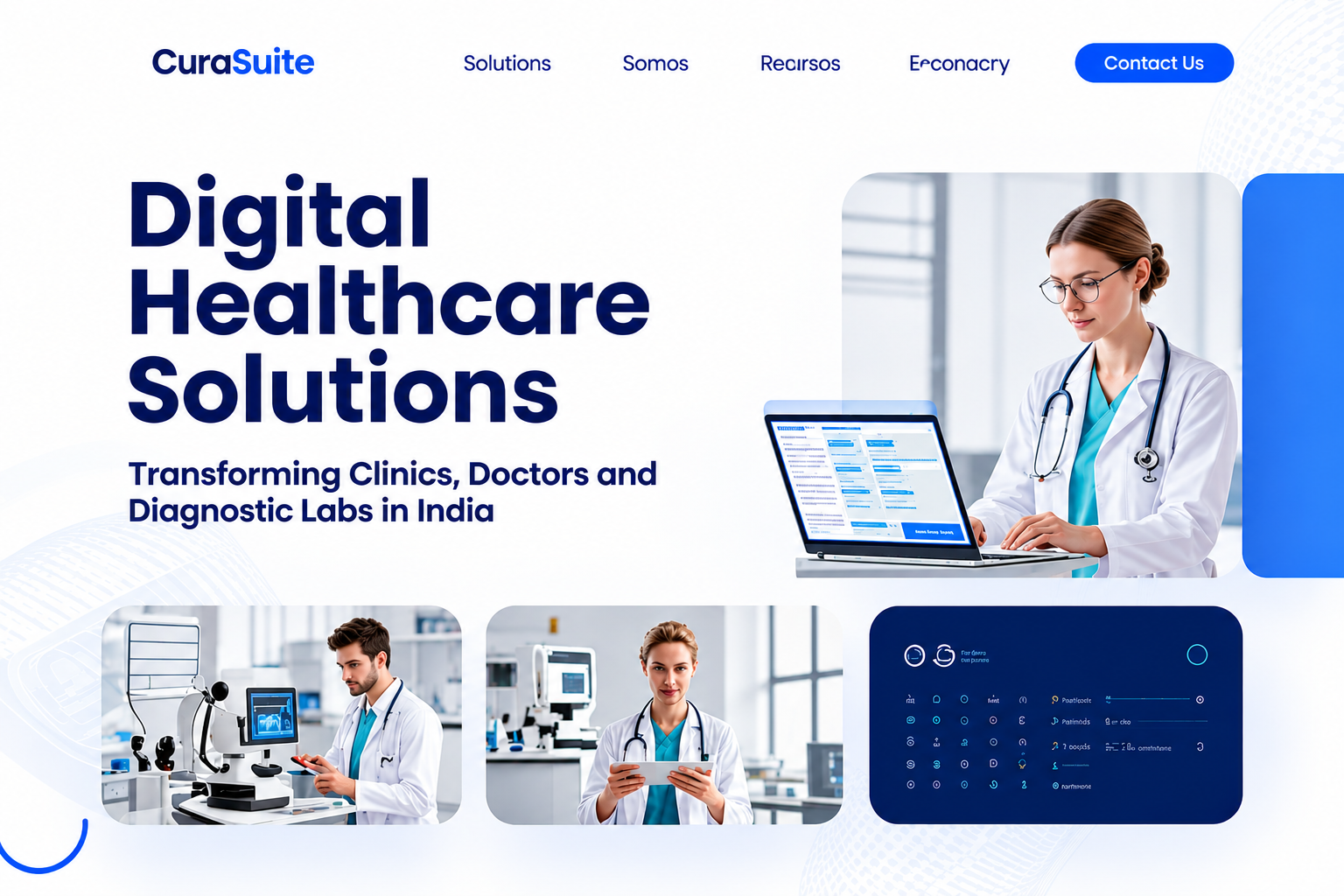
On a Monday morning, a patient makes an appointment. They are asked to have some tests and head down to a diagnostics lab. After waiting some time, they receive a test result sheet. When returning to the clinic, the results are given in a tatty prescription sheet. The clinic receptionist struggles to find the patient’s previous records, and the technician has entered the patients’ name and number for the third time this week.
No one is at fault here. Each component of this example (clinic, GP, and diagnostics) has its own paper-based system, meaning inefficiencies in processing patient information. However, digital healthcare tools are helping to streamline this process. Patients can make appointments online, patient records can be shared between different healthcare professionals, and test results can be received in digital format. In addition, practices can be found by searching on a website.
In 2026, digital healthcare tools are changing how clinics, GPs and diagnostic labs operate within India. This guide will show what types of tools are proving useful currently, what tools are developing, and what points should be considered before investing. This information can help determine which tools would be best suited to your practice.
What are digital health solutions?
They can vary based on the type of facility. In clinics, digital healthcare can refer to booking appointments, maintaining medical records, prescribing care and billing. In laboratories, it refers to registration of patients, tracking of samples and issuing reports. For doctors, digital healthcare can also be a professional, trustworthy website.
Why now?
This can be attributed to the Ayushman Bharat Digital Mission. As of July 2026, over 104 crore health records have been mapped to over 93 crore ABHA accounts (PIB backgrounder from July 2026, Therefore, patients have become familiar with digital health IDs and digital medical records and are beginning to expect similar conveniences from clinics and labs.
Also, receptionists, technicians and doctors have to do repetitive data entry and paper searches. However, digital healthcare solutions may be implemented at different paces. While a single doctor clinic in a small town and a multi-branch diagnostic lab will have very different requirements, infrastructure and budgets, it is best that each business adopts digital healthcare solutions at their own pace.
Important trends in AI in digital healthcare
What’s available now?
Automated prompts, rapidly searching through datasets, using pre-made templates, automating standard documentation and answering routine questions using ‘chatbots’. These features in healthcare technologies mean a small saving of time for many times per day.
What’s on the horizon?
Systems to automatically create notes during consultations and/or suggest treatment options, but these need to be checked by a doctor. This means they are still in early development.
Policy changes
In February 2026, the Ministry of Health and Family Welfare introduced a new strategy for AI in health in India, called the Strategy for AI in Healthcare for India (SAHI). They also created BODH to measure standards of AI tools in health (see PIB explanation). While this is a strategy rather than legislation, it outlines important considerations. Before being implemented in practice, AI systems should be trialled and professionals should remain responsible for decision-making.
To understand how valuable AI features may be to you, consider what the AI does and who verifies that work.
How a Healthcare Management Platform Brings Clinic Operations Together
All of these workflows are integrated into one system. So you don’t have to enter information multiple times.
For example, if a clinic has an on-site sample collection facility, once the patient is registered by reception, the doctors will be able to view their medical history. They can then recommend some tests, and the request goes straight to samples. When results are returned, they will be added to the patient file. Invoicing will be created for both the consultation and tests. The patient name will not need to be re-typed.
Insights
This system can also provide useful insights into how your clinic is doing. You can easily identify peak times, how much work each doctor is performing, how much outstanding money you have and how many tests you are performing. For many clinic owners, this is the first benefit they gain from using a healthcare management platform.
Not all platforms integrate these features. Be specific and ask which parts of the platform integrate with one another. If possible, ask to see this within a demo.
Simplify administrative and clinical processes within the clinic. Common processes include:
Scheduling patient appointments based upon available doctors
OPD waiting list
Records and history, allergies and prescriptions for patients
Templates for prescriptions/records
Charging, receipt printing and monitoring payments
Automated reminders
This reduces duplicated processes. Patients can be reminded of their check-ups in 2 weeks. Fees can be charged on the same screen as recording the visit. The money received in a day can be tallied without manually counting notes.
The effectiveness of these systems depends on configuration and staff training. If a particular process in the clinic has not been considered well, this software will not improve it. Therefore, decide how you would like to operate within your clinic, and ensure that the software matches.
Benefits of laboratory management systems
Enables the lab to perform all the tests required and efficiently produce reports. This includes:
Managing patient information and test orders, including at-home collection appointments.
Easily identifying samples.
Entering results and creating consistent reports.
Managing billing and payments.
Sending digital results to patients and clinicians.
If this system is linked to the practice, patients are not required to come back to receive printed reports. The clinicians will be able to see a patient's results within their notes.
Points to consider
Whilst using software helps maintain good quality processes in your lab, it should not be seen as a replacement for quality processes. If the layout of reports, master list of tests and approvals is incorrectly set up, errors will appear in all reports.
Why use chatbots?
Chatbots can be very useful for answering a wide variety of common patient questions such as when appointments can be made, when reports will be ready, whether an appointment is needed, and if samples can be taken at home. Chatbots can be used to make changes to appointments or book new appointments and inform patients that results are ready.
For labs, this means fewer call-outs to the reception desk. For clinics, it means the receptionist can spend more quality time with people at reception.
Consider
Support for multiple languages (many patients may prefer to speak in Hindi or regional languages)
If the chatbot can’t help in some cases, make sure there is an easy option to pass to staff.
Do not give any medical advice or diagnosis in the chatbot.
Make it clear to patients that they are speaking to an automated service.
Ensure consent and privacy is gained in order to send reminder messages.
The chatbot should be considered an addition to the staff rather than a substitute.
Doctor Website Solutions: Helping Patients Find and Trust Your Practice Online
Patients will often search for information on a GP in advance. A good website will inform patients of what services are available, where the practice is located, opening times and how to make an appointment. In an independent practice, the website may be the first point of contact for patients.
Good examples of websites include accurate opening hours, location (map), contact information and appointment. If linked correctly to the appointment system at the practice, appointments can be made online and added to the same booking system used by the front-of-house staff.
Note: Ensure information is correct and up to date (so patients aren’t frustrated). As doctors in India have guidelines on professional conduct, ensure that any claims/promotional content adheres to current guidelines set by either the National Medical Commission or the medical council of the relevant state.
Data Protection
With ABDM, we have a national infrastructure for digital healthcare. ABHA allows individuals to securely share their data between different facilities. Through Scan and Share, which reduces registration time in participating facilities, over 23 crore ABHA-linked tokens have been issued as of June 2026 [as reported by DD News
The mission has also been integrated with over 450 public and private health tech solutions [according to the Health Ministry].
Depending on the product, be sure to check what functionality is available within the solution. If possible, check how this functionality works in practice.
Protection of Data legislation exists in India from November 2025. Requirements become active for clinics/labs in May 2027. [PIB backgrounder]
It would make sense to begin preparing for this legislation. Within your clinic/lab, ensure consent is well documented, access permissions are role-based, audit trails are in place, backups have been tested and a plan for managing incidents has been put in place. Consider seeking professional advice on how this legislation will impact you.
Digital Transformation in Healthcare: How to Start Without Disrupting Your Practice
To successfully introduce digital transformation in your practice, it can be good to implement it in small parts.
Plan:
Select 1-2 problematic processes within a department to improve. For example, in a clinical setting you may wish to improve appointment management and invoicing. In a lab, patient registration and reporting may be a focus.
Select an appropriate system and get a demonstration of the system based on your scenarios
Plan how to move data from paper systems. This should be done in phases.
Ensure training is given to all users of the system. It may be useful to train both receptionists and technicians.
If practical, a parallel running period may be useful to allow you to transition fully over to the new system. Once confident, make the transition.
After a few weeks, review how it is working. Make improvements where needed before adding in another process.
By taking this approach, your team will feel the software is supporting them.
Consider what the system can offer and if it fits you and your clinic/labouratory.
Will it support the processes in your clinic/laboratory?
Is there data sharing between modules?
How easily can staff and doctors get to grips with the software?
How are permissions, backups, and exporting of data managed?
What ABDM functionality can it offer? Can they demonstrate this?
What support and training is offered? How often will updates be released?
Can it scale if we take on more staff/branches/tests?
What is the total cost (setup and subscription)?
Ask for a demonstration specific to your working day in practice. Long lists of features may not be a good indicator of good software. The right choice for you will be something you and your staff will use daily.
FAQs
1. How do digital health solutions improve processes in clinics and labs?
Digital health solutions allow for more efficient processes in clinics, doctors’ practices and labs and can include booking, storing patient information, generating invoices, lab result reports, reminders, and having an online presence. These solutions mean less data duplication within clinics, improved tracking of samples and sharing reports within labs, and allowing doctors to be found by patients through a website. How beneficial the solution is will depend on the product itself and staff training.
2. What is AI used for?
AI is being used in digital health systems to provide reminders, search records, create documentation and answer general questions from patients. AI systems to create clinical documentation and support clinical decision-making are being developed but require careful verification. In February 2026 a strategy was introduced in India (SAHI) to describe the governance of healthcare AI. Any information provided by AI should be checked by a professional.
3. Can AI chatbots be used in clinics/labs?
Yes. They can be used to answer questions, make or rearrange appointments, remind patients of appointments and inform patients when their reports are ready. They must not provide medical advice. If appropriate, they should refer to a member of staff. Consent and privacy must be respected. The quality of the AI chatbot will depend on what languages it supports and how well it has been adapted for your specific clinic/lab.
4. What should clinics check about ABDM and data protection before choosing healthcare software?
Ask what ABDM functionality is supported by the system. Ask to see a demonstration. For data protection, ask how consent is handled within the system, role-based security, audit trails, backup systems, and the processes in place if there is a data breach. In India, personal data is covered by the DPDP Act. The key requirements will be in place from May 2027. Therefore, it is advisable to start preparing early and seek professional guidance.
5. How will we start implementing this without causing too much disruption?
Choose one or two processes (bookings and billing, or registration and reports) to go digital. Select an appropriate application for you, train your staff in it and begin gradually migrating data. After running it in this way for a few weeks, consider reviewing how it is working. You may wish to add further processes into it gradually. A slow implementation is generally less disruptive for staff.
Conclusion
Across clinics, doctors and diagnostic labs in India, digital workflows provide a more efficient, secure and easily searchable solution than current paper-based processes and registers. By carefully selecting appropriate digital healthcare solutions, implementing them in stages, and allowing trained staff to use them, many benefits can be reaped. AI solutions can be very beneficial in certain situations; however, clean data, clear patient consent and manual oversight should also be present.
At Cura, we designed solutions to help healthcare providers in India improve. With CuraSuite for full clinic management, CuraLabs for pathology testing, and CuraCMS for professional websites for a doctor/clinic, we have something to suit your specific needs. Find out how you could develop your clinic or laboratory further by visiting CuraSuite, and booking a demo!
Related Articles
How AI Is Transforming Healthcare Management Platforms in India in 2026
Discover how artificial intelligence is transforming healthcare management in India. Explore the latest AI trends, …
How To Digitize A Clinic: A Step-By-Step Guide For Healthcare Providers
Learn how to digitise your clinic step by step, from assessing daily workflows and choosing …
How AI Is Transforming Healthcare in India
AI is no longer science fiction in Indian healthcare. From diagnostic assistance to patient chatbots, …